|
 |
|
|
| Missing In Action (MIA) | Prisoners Of War (POW) | Unexploded Ordnance (UXO) |
| Chronology | Locations | Aircraft | Ships | Submit Info | How You Can Help | Donate |
|
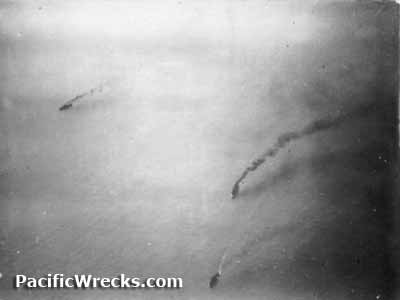 43rd BG March 3, 1943 |
Location The Bismarck Sea spans from the northern coast of New Guinea with New Britain to the east and the Admiralty Islands to the north. The Dampier Strait and Vitiaz Strait are to the south and connect to the Solomon Sea. Named by the Germans in honor of German chancellor Otto von Bismarck. Prewar and during the Pacific War located in the Territory of New Guinea. Today located in Morobe Province in Papua New Guinea (PNG). Battle of the Bismarck Sea The Battle of the Bismarck Sea occurred during March 2-4, 1943 when Allied aircraft attacked and sank a Japanese convoy of eight transports escorted by eight destroyers that departed Rabaul loaded with reinforcements and supplies bound for Lae. The battle was an Allied victory as they sank all eight transports and four destroyers. Nearly 3,000 Japanese were killed and only 850 troops managed to reach Lae. The battle was the conducted by only Allied aircraft that employed new tactics including skip bombing. P-38G Lightning 42-12715 Pilot Shifflet MIA March 3, 1943, 1 missing P-38F Lightning 42-12623 Nose 16 Pilot Faurot MIA March 3, 1943 B-17F "Ka-Puhio-Wela" 41-24356 Pilot Moore MIA March 3, 1943 Kyokusei Maru Sunk by Allied aircraft March 2, 1943 first ship sunk during the Battle of Bismarck Sea Aiyo Maru Sunk by Allied aircraft March 3, 1943 during Battle of Bismarck Sea Oigawa Maru (Oikawa) Sunk by Allied aircraft March 3, 1943 during Battle of Bismarck Sea 30 miles southeast of Finschafen Teiyo Maru Cargo 6,801 tons. Sunk by Allied aircraft March 3, 1943 Taimei Maru Cargo 2,883 tons. Sunk by Allied aircraft March 3, 1943 Sin-ai Maru Cargo 3,793 tons. Also known as Shin-ai Maru or Sinai Maru. Sunk by Allied aircraft March 3, 1943 Kembu Maru Cargo 954 tons carrying gasoline. Sunk by Allied aircraft March 3, 1943 Nojima Maru Transport 8,750 Tons. Also known as Noshima Maru or Nozima Maru. Sunk by Allied aircraft March 3, 1943 Asashio Destroyer 2,370 tons. Sunk by Allied aircraft March 3, 1943 Shirayuki Destroyer 2,090 Tons. Sunk by Allied aircraft March 3, 1943 Tokitsukaze Destroyer 2,490 Tons. Sunk by Allied aircraft March 3, 1943 Arashio Destroyer 2,370 tons. Sunk by Allied aircraft March 4, 1943 Ki-21-II Sally Shot down February 25, 1944 Bismarck Sea flying to the southeast towards Rabaul Contribute
Information Last Updated
|
| Discussion Forum | Daily Updates | Reviews | Museums | Interviews & Oral Histories |
|