|  |
|
| |
|
| Missing In Action (MIA) | Prisoners Of War (POW) | Unexploded Ordnance (UXO) |
| Chronology | Locations | Aircraft | Ships | Submit Info | How You Can Help | Donate |
|
| IJN Passenger and cargo vessel Armed Merchant Cruiser 10,437 Tons 527' 7" x 66' 3" x 28' 10" Armament 1940-1941 4 x 152mm guns 2 x 76mm AA guns 2 x 13mm MG 2 x torpedo tubes 2 x E7K Alf floatplanes Armament 1942 8 x 140mm guns 2 x 76mm AA guns 2 x 13mm MG 2 x torpedo tubes 2 x E7K Alf floatplanes 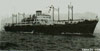 OSK 1941 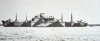 IJN 1942  IJN 1944 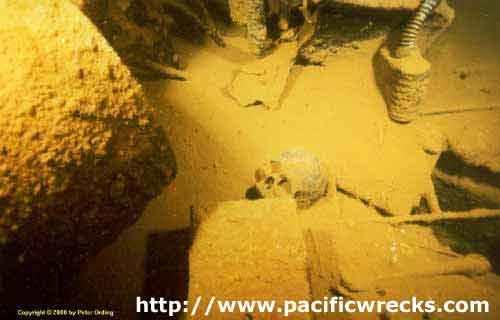 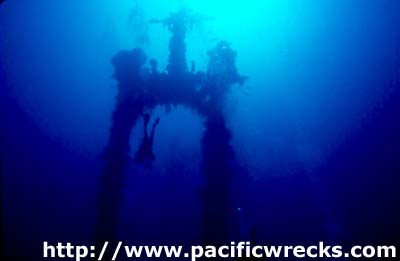 Peter Ording 2000 |
Ship History Built by Mitsui Engineering & Shipbuilding at the Tamano shipyards in Okayama, Japan. Purchased by the Osaka Shosen KK (OSK Line) with Japanese government subsidies as a combined luxury passenger liner and cargo vessel for South America and around the world service. The vessel was provisionally to be named "Kyoto". Laid down December 29, 1938 as a luxury passenger liner and cargo vessel. Launched April 25, 1940 as Aikoku Maru. Completed August 31, 1941. Wartime History On September 1, 1941 requisitioned by the Imperial Japanese Navy (IJN). On September 5, 1941 placed under the command of Rear Admiral (retired) Masao Okamura and registered in the Kure Naval District and began conversion into an armed merchant cruiser armed with four 152mm guns, two 76mm AA guns, two 13mm machine gun plus two torpedo tubes were installed by Mitsui Engineering & Shipbuilding, 1100mm and 900mm searchlights and a boom for a single E7K Alf reconnaissance floatplane plus one spare. On October 15, 1941 the conversion is completed and the same day assigned to the 24th Squadron (Raider) under Rear Admiral Takeda Moriji and attached to the Combined Fleet, CruDiv 24 with Hokoku Maru and Kiyosumi Maru. The ship is painted with false markings to disguse the fact it is a raider. On October 31, 1941 departs Tamano bound for Kure. On November 13, 1941 departs Kure and the same day arrives at Iwakuni. On November 13, 1941 at 7:35pm departs Iwakuni with Hokoku Maru bound for Jaluit Atoll. On November 24, 1941 arrives at Emidj to refuel and resupply and three days later departs ahead of hostilities bound for the South Pacific. Wartime History On December 8, 1941 at the start of the Pacific War with Hokoku Maru northeast of the Tuamotu Islands in French Polynesia steaming to the southeast. On December 13, 1941 north of Pitcairn Island spots and overtakes SS Vincent. At 7:07pm Hokoku Maru fires eight shells causing a fire and the crew abandon ship before torpedoed and sunk at roughly Lat 22° 41' S, Long 118° 19' W. The crew are rescued by Hokoku Maru and become prisoners. On December 31, 1941 in the afternoon launches her E7K2 Alf floatplane that locates SS Malama and circles several times then departs to the east then returns and circle twice more then departs to the west and fails to return. Afterwards, both Aikoku Maru and Hokoku Maru search but find no trace of the floatplane or crew. On January 1, 1942 at 9:00am of the Cook Islands and Society Islands launches her second E7K2 Alf floatplanes that circles the ship and begins strafing and orders SS Malama to stop using international code. Afterwards, the floatplane returns to Aikoku Maru and is armed wit four bombs then took off again bound for SS Malama. At 2:30pm the crew scuttle the ship and everyone aboard boards two lifeboats as the floatplane drops four bombs that cause fires aboard. The ship sinks at Lat 26°21'N, Long 153°24'W. The Japanese report the sinking location as Lat 26° 39' S, Long 151° 24' W. On January 20, 1942 the pair of armed merchant cruiser depart their assigned area ending their patrol bound for the Gilbert Islands where the false markings are removed. On February 4, 1942 arrives Truk and the next day depart bound for Hashirajima but while enroute are directed to Oita to disembark the prisoners. Rear Admiral Takada recommends preparations be made for their arrival as the prisoners have no winter clothing. On February 11, 1942 intercepts a vessel that is identified as Soviet transport Kim. On February 13, 1942 arrives Oita and disembarks 76 prisoners from SS Vincent and SS Malama and the same day departs for Hashirajima arriving later in the evening. On February 14, 1942 arrives Kure and undergoes refit and the armament is modernized with the four 152mm guns removed and replaced by eight 140mm guns. During March 1942 converted to transport submarine torpedoes in one of the cargo holds plus supplies to serve as mother ships. On March 10, 1942 departs Kure for Hashirajima and with Hokoku Maru are attached to the Sixth Fleet to service submarines to provide torpedoes, stores, diesel fule and accompany submarines operating off the eastern coast of Africa. On March 29, 1942 attached to SubRon 8. On April 12, 1942 departs Kure bound for Hashirajima arriving three days later in the evening with Hokoku Maru, Katori, Chiyoda and other vessels. On April 16, 1942 Rear Admiral (retired) Okamura visits Admiral Yamamoto aboard Yamato. At 11:00am departs with Katori bound for Singapore and Penang then will support SubRon 8, SubDiv 1's I-10, I-16, I-18, I-20, and I-30 in the western Indian Ocean. On April 20, 1942 refuels I-30. On April 27, 1942 again refuels I-30. On April 30, 1942 arrives Penang. On May 5, 1942 departs Penang with Hokoku Maru. On May 9, 1942 captures Dutch tanker Genota at roughly Lat 17° 40' S, Long 76° 20' E. PARTIAL HISTORY On April 30, 1942 arrives Penang with Hokoku Maru to support SubRon 8 "KO" (A) detachment submarines I-10, I-16, I-18, I-20 and I-30 for operations in the western Indian Ocean. On May 5, 1942 departs Penang with Hokoku Maru. PARTIAL HISTORY On April 5, 1943 assigned to Captain Shojiro Mizusaki. PARTIAL HISTORY On October 20, 1943 assigned to captain Yoshizo Nakamaruo. PARTIAL HISTORY On February 16, 1944 anchored in Truk Lagoon inside the 4th Fleet anchorage on the east side of Dublon Island. Immediately, the ship began loading munitions bound for Rabaul. Aboard were 400 troops from Japanese Navy 1st Amphibious Brigade who were billeted in the aft cargo hold no. 4, which was converted into makeshift quarters. Sinking History On February 17, 1944 at 8:15am attacked by U.S. Navy (USN) carrier planes from USS Intrepid (CV-11). During the attack, a bomb hit the officer's wardroom galley and starts a fire that spreads quickly. Other aircraft score three additional bomb hits. At roughly 8:30am, TBM Avenger 25270 dropped an aerial torpedo that impacted the ship's no. 1 cargo hold and detonates stored ordnance. The resulting explosion nearly shears off the entire fore ship and claims the attacking Avenger in the blast. Aboard, many of the crew and passengers were killed instantly by the shock wave. The ship sank in within a minute into Truk Lagoon at roughly Lat 7° 22' N, Long 151° 56E. Aboard, captain Nakamaruo, 945 crew, passengers and 400 troops went down with the ship. On March 30, 1944 officially removed from the Navy List and Captain Nakamaruo was posthumously promoted to Rear Admiral. The Japanese version of the sinking was that "a Grumman crashed near the bridge of the ship and caused a big pillar of fire and black smoke with an explosion. From this explosion, the ship started sinking and went completed under at 0830h". The perception that this Avenger crashed into the ship might be how it was observed from the vantage point of survivors. Shipwreck During 1969, this shipwreck was first documented by members of Jacques Cousteau's documentary dive team. Footage of this shipwreck appeared in Lagoon of Lost Ships (1969). At that time, the shipwreck was not identified. Recovery of Remains In July 1980, divers recovered the remains of approximately 400 individuals from the shipwreck. These remains are cremated during a Shinto ceremony and the ashes returned to Japan. Today, the forward section of ship disintegrated during the explosion. The interior may be penetrated at great risk due to silt and debris. Peter Ording adds: "This was one of my more memorable dives, the engine room photos at a depth of 200' not exactly a routine dive." References Combined Fleet - IJN Aikoku Maru: Tabular Record of Movement Lagoon of Lost Ships includes dive footage of this wreck in 1969 Research Notes on Jacques Cousteau's Lagoon of Lost Ships WWII Wrecks of the Truk Lagoon (2001) pages 266, 270-281 (photos, dive map), 282, 385-386, 415, 501 (index) Contribute
Information |
 230'  Photo Archive |
| Discussion Forum | Daily Updates | Reviews | Museums | Interviews & Oral Histories |
|