|  |
|
| |
|
| Missing In Action (MIA) | Prisoners Of War (POW) | Unexploded Ordnance (UXO) |
| Chronology | Locations | Aircraft | Ships | Submit Info | How You Can Help | Donate |
|
| USN (As Built) Freighter (Conversion 1941) Long Island-class Escort Carrier 13,499 Tons 492' x 69' 6" x 25' 8" 1 x 5"/51 cal gun 2 x 3"/50 cal guns Aircraft: 30 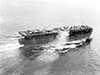 USN May 25, 1943 |
Ship History Built by Sun Shipbuilding & Drydock Company in Chester, Pennsylvania. Laid down July 7, 1939 under a Maritime Commission contract as a C-3 cargo liner with yard number 185. Launched January 11 1940 as SS Mormacmail sponsored by Ms. Dian B. Holt, daughter of Mr. George L. Holt, vice president of Mooremack for use by Moore-McCormack Lines (Mooremack). In early March 1941 arrived Newport News, Virginia. On March 6, 1941 acquired by the U.S. Navy (USN) and converted into an aircraft carrier AVG-1 at Newport News Shipbuilding and Drydock Company. Commissioned June 2, 1941 in the U.S. Navy (USN) as USS Long Island (AVG-1) named for Long Island in New York State, the lead ship of the Long Island-class escort carrier under the command of Commander Donald B. Duncan and was used to ascertain if carrier operations were possible from a converted cargo ship. The first squadron attached was VS-201 (VC-1). On July 1, 1941 a SOC-1 piloted by LtCdr. W. D. Anderson landed the first plane aboard the carrier, followed by F2A-1 Buffalo piloted by by Lt. Lex L. Black and the same day departs Norfolk for a cruise in the Atlantic Ocean then was ordered to the Newfoundland area. In early August 1941, reviewed by U.S. President Franklin D. Roosevelt aboard USS Augusta (CA-31) while attending the Atlantic Charter Conference. In November 1941, arrives Philadelphia, PA for repairs to the catapult then departs for Bermuda. Wartime History On December 7, 1941 in the morning at anchor in Grasse Bay in Bermuda then departs for Norfolk arriving seventeen days later and placed under the command of Commander J.D. Ballantine. On December 26, 1941 departs escorting a convoy bound for Newfoundland. In late January 1942 returns to Norfolk with USS Wasp (CV-7) escorted by USS Stack (DD-406) and USS Sterett (DD-407). Next, conducts carrier qualifications for new pilots. On May 10, 1942 departs Norfolk via the Panama Canal bound for San Diego arriving at the end of the month then ordered to San Francisco. On June 5, 1942 joins Task Force 1 (TF 1) to provide air cover for seven battleships and protect the west coast of the United States. On June 17, 1942 leave the task force and returns to the west coast to continue carrier pilot training. On July 8, 1942 departs San Diego bound for Pearl Harbor arriving nine days later then conducts a training mission south to Palmyra Island then returns to Pearl Harbor. On August 2, 1942 embarks two U.S. Marine Corps squadrons including Marine Fighting Squadron 223 (VMF-223). On August 3, 1942 departs Pearl Harbor bound for the South Pacific (SoPAC) via Fiji and Efaté then proceeds to a point 200 miles southeast of Guadalcanal and launched her planes including 19 F4F Wildcats and 12 SBD Dauntless dive bombers that landed at Henderson Field. On August 20, 1942 redesignated as an Auxiliary Aircraft Carrier and redesignated USS Long Island (ACV-1). Departs for the South Pacific. On August 17, 1942 arrives Vila and departs the next day then returns at the end of the month. On September 1, 1942 departs for Espiritu Santo then back across the Pacific to the west coast. On September 20, 1942 arrives San Diego and trains carrier pilots. On July 15, 1943 reclassified as an Escort Carrier USS Long Island CVE-1. During 1944 and 1945, transports planes and crew from the west coast to bases in the Pacific. Postwar At the end of the Pacific War, transports American personnel back to the United States. On March 26, 1946 decommissioned at at Puget Sound Naval Shipyard. On April 12, 1946 stricken from the Navy registry. On April 24, 1947 sold to Zidell Ship Dismantling Company in Portland, Oregon. On March 12, 1948 sold to Europe-Canada Line and converted back into a merchant ship by Albina Engineering & Machine Works and renamed Nelly. Used as an immigrant carrier between Europe, Australia and Canada. In 1953, sold to the University of the Seven Seas and renamed Seven Seas and converted into a school ship. During 1955, chartered to the West German Europe-Canada Line. On July 17, 1965 while underway at sea, suffered a serious fire and was towed to St John's, Newfoundland for repairs. On September 13, 1966 departed St John's on what would be her final voyage back to Europe and purchased by Rotterdam University and moored at Rotterdam and used as a floating student hostel and later became a hostel for shipyard workers until early 1977. Fate During May 1977, scrapped in Ghent, Belgium and broken up for scrap. Awards For her World War II service, earned one battle star. References NARA USS Long Island (CVE-1) War Diary March 1941–2 September 1945 (1946) NavSource - USS Long Island (AVG-1) later ACV-1 and CVE-1 Contribute
Information |
| Discussion Forum | Daily Updates | Reviews | Museums | Interviews & Oral Histories |
|