|  |
|
| |
|
| Missing In Action (MIA) | Prisoners Of War (POW) | Unexploded Ordnance (UXO) |
| Chronology | Locations | Aircraft | Ships | Submit Info | How You Can Help | Donate |
|
| USN Panay-class river gunboat 474 Tons 191' x 29' 5' 3" 2 x 3" guns 8 x .30 caliber MG 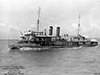 USN August 30, 1928 |
Ship History Built by the Jiangnan (Kiangnan) Dockyard and Engineering Works in Shanghai. Laid down in 1927 as Panay-class river gunboat. Launched November 10, 1927 as USS Panay (PG-45) named for Panay sponsored by Mrs. Ellis S. Stone. Reclassified as PR-5. On August 30, 1928 photographed during trails off Wusong (Woosung). Commissioned September 10, 1928 in the U.S. Navy (USN) as the second ship with the name under the command of LtCdr James M. Lewis with a complement of 59 officers and sailors. Assigned to the Asiatic Fleet and operated on the Yangtze River to protect American and foreign shipping and citizens. Armed guards from Panay were also detached to serve aboard U.S. vessels operating on Yangtze River. On February 15, 1929 assigned to LtCdr Lee C. Carey. On August 28, 1930 assigned to LtCdr Robert A, Dyer, Jr. On June 27, 1931 assigned to LtCdr William J. Morcott. On December 30, 1932 assigned to Russell S. Berkey. On July 6, 1934 assigned to LtCdr Edward H. Jones. On June 12, 1936 assigned to LtCdr James J. Hughes until sunk. During November 1937 in the Second Sino-Japanese War, evacuated U.S. embassy personnel from Nanking. Afterwards, remains in the vicinity to guards the remaining staff. On December 11, 1937 evacuates civilians from Nanking including the four remaining embassy staff plus ten civilians including correspondents Universal News cameraman Norman Alley, Movietone News’ Eric Mayell, The New York Times' Norman Soong, Collier's Weekly correspondent Jim Marshall, La Stampa correspondent Sandro Sandri and Corriere della Sera correspondent Luigi Barzini Jr. With the passengers embarked, Panay moves upriver with three U.S. tankers owned by Standard Oil: Mei Ping (Meiping), Mei An (Meian), and Mei Hsia (Meihsia). All the ships were flying large U.S. flags and one had a U.S. flag painted atop the cabin. Meanwhile, the Japanese Naval commander in Shanghai was informed of their movement before and after. Sinking History On December 12, 1937 Panay and the three tankers were anchored in the Yangtze River at "mileage 221 above Woosung” roughly 29 miles away from Nanking. the Imperial Japanese Navy (IJN) was ordered to attack "any and all ships" in the Yangtze River upriver from Nanking. Aware there were American vessels, clarification of the order was requested and received. At 1:27pm, targeted by Japanese planes including three B4Y Type 96 bombers from 13th Kokutai (13th Air Group) armed with 60 kg bombs escorted by nine A4N Type 95 fighters. At 1:30pm Panay ceased a radio transmission in the midst of a message to USS Luzon (PR-7) that in turn immediately reports to the U.S. Ambassador to China, Nelson T. Johnson who then reports to U.S. Secretary of State Cordell Hull and requested that he notify the Japanese Government of Panay's last reported location. During the attack, Panay was hit by two 60 kg bombs and damaged. Aboard, three were killed: Storekeeper First Class Charles L. Ensminger, Standard Oil tanker captain Carl H. Carlson and Italian reporter Sandro Sandri. Coxswain Edgar C. Hulsebus was severely wounded and later died of wounds. A total of 43 sailors and five civilians were wounded. Cameramen, Norman Alley of Universal Newsreel and Eric Mayell of Fox Movietone News filmed during the attack and after the sinking continued to shoot film from shore. Six days later on December 18, 1937 the film footage departs Shanghai aboard USS Stewart (DD-224) and is later shown worldwide as Universal Newsreel "Bombing of U.S.S. Panay". At 3:54pm sank in the middle of the Yangtze River near Hanshan Island off Ma'anshan in Anhui Province in eastern China. As the ship sank, Panay's lifeboats were strafed by the fighter. The survivors managed to reach shore and waded in muddy water to a nearby village, carrying those too wounded to walk. During the same attack, also sunk was Mei Ping (Meiping) and Mei Hsia (Meihsia). Damaged, Meian was beached. Later that same day, the same aircraft attacked British ship SS Wantung. Rescue Afterwards, the survivors were embarked aboard USS Oahu (PR-6) and British gunboats HMS Ladybird and HMS Bee. In total, it took three days to move the sixteen wounded to several British and American ships. Panay Incident Afterwards, the sinking was known as the "Panay Incident". The United States government and citizens were shocked and concerned by the bombing of American and other non-Chinese vessels. A formal protest was made by the U.S. Ambassador in Japan to the Foreign Minister of Japan who expressed profound apologies for the unfortunate mistake. With ample eyewitness accounts, the Panay Incident was extensively covered by the press and the diplomatic exchanges. On December 25, 1937 the Japanese Government declared that investigations had proved the attack to be unintentional and accepted full responsibility. In response to American claims for indemnification totaling $2,214,007.36. On April 22, 1938 the Japanese Government delivered a cheque for the full amount requested for "settlement in full" to the U.S. Ambassador to formally settle the Panay Incident. Awards For his actions, Lt. Arthur F. Anders earned the Navy Cross, in 1939 changed to the Distinguished Service Medal (DSM) and in 1969 was again bestowed the Navy Cross. For his actions, LtCdr James Joseph Hughes earned the Navy Commendation Medal with Combat V and the Purple Heart for wounds he sustained. Memorials Ensminger died on December 12, 1937 in the attack. On March 7, 1938 buried at Arlington National Cemetery at section 17 grave 20419-H. Carlson died on December 12, 1937 in the attack. Later, he was buried at Bubbling Well Road Cemetery in Columbaria F, Niche No. 27. Sandro Sandri died on December 12, 1937 in the attack. He is buried at Cimitero del Borgo in Bellagio, Italy. Coxswain Edgar W. G. Hulsebus wounded December 12, 1937 later died of his wounds on December 19, 1937. He is buried at Forest Grove Cemetery in Canton, Missouri. Hughes died November 24, 1953 at age 55. He is buried at Arlington National Cemetery in section 7 site 9993-2. On April 3, 1943 USS Midway (AG-41) was renamed USS Panay as the third ship with the name to release the name for Casablanca-class escort carrier USS Midway later renamed USS St. Lo (CVE-63). References Universal Newsreel "Bombing of U.S.S. Panay" film by Norman Alley narrated by Graham McNamee USN "U.S.S. Panay, loss by sinking as a result of bombing by Japanese planes 12 December 1937” by Lieutenant Commander J. J. Hughes, the Commanding Officer, U.S.S. Panay, to The Secretary of the Navy, 21 December 1937 Naval History and Heritage Command (NHHC) - Panay II (PR-5) Naval History and Heritage Command (NHHC) - The Panay Incident 12 December 1937 Hall of Valor - Arthur F. Anders (Navy Cross citation) Arlington National Cemetery (ANC Explorer) - Charles L. Ensminger (grave photos) FindAGrave - Charles Lee Ensminger (grave photo) FindAGrave - Carl Harry Carlson FindAGrave - Sandro Sandri (photos) NavSource - USS Panay (PR-5) (photos) FindAGrave - CDR James Joseph Hughes (photo, Arlington National Cemetery) U.S. Naval Institute Proceedings "How The Panay Was Sunk" by Masatake Okumiya assisted by Roger Pineau Vol. 79/6/604 June 1953 U.S. Naval Institue Proceedings "The Panay Incident: Prelude to Pearl Harbor" by Harlan J. Swanson Vol. 93/12/778 December 1967 AP "Last Survivor Recalls 1937 Attack Off China" by Ted Morris January 6, 2008 The USS Panay Memorial Website via Wayback Machine March 2, 2021 Contribute
Information |
| Discussion Forum | Daily Updates | Reviews | Museums | Interviews & Oral Histories |
|