|
 |
|
|
| Missing In Action (MIA) | Prisoners Of War (POW) | Unexploded Ordnance (UXO) |
| Chronology | Locations | Aircraft | Ships | Submit Info | How You Can Help | Donate |
|
| USN Brooklyn-class light cruiser 10,160 Tons (Standard) 13,541 Tons (Full Load) 608'4" x 61'8" x 25'10" 5x3 6" 47cal mark 16 guns 4x2 5" 38cal AA guns 4x4 40mm AA guns 20 x 20mm cannons 2 x SOC floatplanes 2 x stern catapults 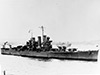 USN 1943 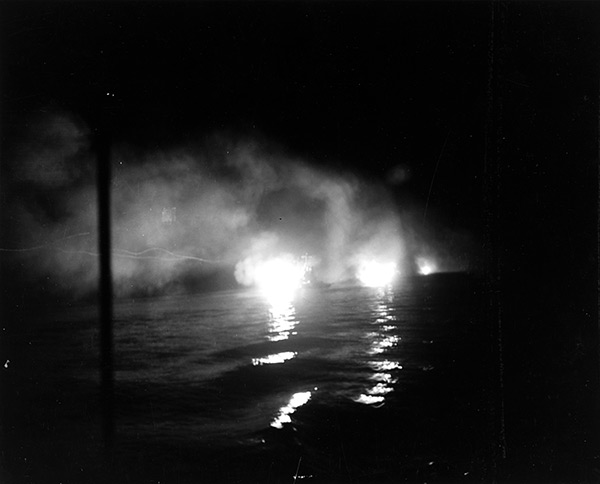 USN July 6, 1943 |
Ship History Built at the New York Navy Yard in Brooklyn, New York. Laid down December 9, 1936 as a Brooklyn-class light cruiser. Launched August 27, 1939 as USS Helena (CL-50) for Helena, Montana. Commissioned September 18, 1939 in the U.S. Navy (USN). Pearl Harbor On December 7, 1941 moored at Pearl Harbor in a berth normally assigned to USS Pennsylvania (BB-38). During the first wave of the Japanese surprise attack, a B5N1 Kate torpedo bomber from Soryu released a torpedo that hit her on the starboard side in the engine room. Quick damage control efforts saved the ship from further damage. Afterwards, repaired and overhauled at Mare Island. Returning to combat, Helena escorted a detachment of Naval Construction Battalion (NCB) "Seabees" and an aircraft carrier from Espriritu Santo northward to Guadalcanal. On September 12, 1942 she helped rescue survivors of USS Wasp (CV-7) after the aircraft carrier was torpedoed. Afterwards, escorted transports bound for Guadalcanal. On October 7, 1942 assigned to Task Force 64 (TF-64) funder the command of Rear Admiral Willis Lee formed around USS Salt Lake City (CA-25), USS Boise (CL-47), USS Helena (CL-50) and USS San Francisco (CA-38) at Espriritu Santo then departs for Guadalcanal to intercept Japanese "Tokyo Express" runs bound for Guadalcanal. On October 11, 1942 at 11:35pm Helena, equipped with SG radar, was first to contact the enemy and first to open fire at 11:46pm at the start of the Battle of Cape Esperance (Second Battle of Savo Island). Gunfire from Helena sank Heavy Cruiser Furutaka and Destroyer Fubuki. Afterwards, assigned to Task Force 64 (TF 64) under the command of Rear Admiral Willis Lee with battleship USS Washington (BB-56), USS San Francisco (CA-38) and USS Atlanta (CL-51) with six destroyers. During the night of October 20, 1942 while patrolling between Espriritu Santo and San Cristobal a Japanese submarine fired several torpedoes at Helena that exploded nearby but was not hit. On October 25, 1942 participated in the Battle of the Santa Cruz Islands but saw no action and afterwards returns to Guadalcanal. On November 4, 1942 Helena, USS San Francisco (CA-38) and USS Sterett (DD-407) provide fire support against Japanese forces on Koli Point. Afterwards, reassigned to Task Force 67.4 (TF 67.4) under the command of Rear Admiral Daniel J. Callaghan as part of the support group, to provide close support for transports bound for Guadalcanal. The force includes heavy cruisers USS San Francisco (CA-38) and USS Portland (CA-33), light cruisers USS Atlanta (CL-51), USS Helena and USS Juneau (CL-52) with destroyers USS Cushing (DD-376), USS Laffey (DD-459), USS Sterett (DD-407), USS O'Bannon (DD-450), USS Aaron Ward (DD-483), USS Barton (DD-599), USS Monssen (DD-436) and USS Fletcher (DD-445). On November 11, 1942 escorted transports to Guadalcanal. Naval Battle of Guadalcanal On November 12, 1942 in the afternoon Japanese artillery opened fire on the transports and Helena and destroyers returned fire until a Japanese air raid commenced. During an eight minute air raid by G4M1 Bettys each armed with a torpedo escorted by A6M2 Zeros, the force maneuvered as anti-aircraft fire broke up the first attack. The second wave damaged two ships but Helena was undamaged. The force claimed eight planes shot down. On November 13, 1942 in the early morning, the first phase of the Naval Battle of Guadalcanal began with the American force in a single column formation with the destroyers in the lead with the cruisers in the center. At 1:24am Helen's SG radar detected the Japanese force under the command of Vice Admiral Hiroaki Abe but the the report was not communicated in time due to radio trouble and confusion. Minutes later, both forces spotted each other at roughly the same moment visually. The Japanese warships were surprised and their guns loaded for the shore bombardment but decided to proceed. Meanwhile, Americans orders to attempt a "cross the T" maneuver but the Japanese force was scattered in several groups and orders were delayed as the U.S. line began to fall apart. The two forces began to overlap as they waited for permission to open fire. During the battle, Helena received only minor damage from five hits to her superstructure that caused negligible damage and killed one sailor. At the end of the confused action, one of Helen's 40mm guns fired at cruiser Nagara passing in the opposite direction as her guns fired at the retreating Japanese warships. When the 38 minute action ended at 2:26am, the American force withdrew to the southeast as the Japanese withdrew in the opposite direction. On January 1, 1943 as part of Task Force 67 (TF-67) Helena was part of the covering force for seven transports that landing the U.S. Army 25 Infantry Division on Guadalcanal. New Georgia Bombardment On January 4, 1943 Helen, USS St. Louis and USS Nashville with two destroyers detach as Task Force 67.2 (TF-62.2) under the command of Rear Admiral Walden L. Ainsworth to bombard Munda on New Georgia. On January 5, 1943 in the early morning the force bombards Munda Airfield and Munda. Although the warships fire 4,000 shells, they causes little damage then departs. By 9:00am, the bombardment force returns to Guadalcanal and rejoins TF-67 and was subjected to a Japanese air raid. During this action, Helena becomes the first U.S. Navy ship to use Mk. 32 proximity-fuze (VT-fuze) shells in combat, shooting down a Japanese Aichi Type 99 carrier bomber / D3A Val with her second salvo. Afterwards, departs south to Espriritu Santo to refuel and resupply. On January 22, 1943 departs Espiritu Santo northward on a mission to bombard Vila Airfield on Kolombangara Island. On January 23, 1943 in the early morning, Helena, Nashville and four destroyers entered Kula Gulf and fired 3,500 shells while a PBY Catalina provided aerial spotting support. The force withdrew into rain storms chased by Japanese floatplanes and bombers, firing radar directed 5" gunfire at the attackers. On January 25, 1943 returns to Espriritu Santo. Afterwards, continues to operate with Task Force 67 (TF-67) and performs patrols and escorts convoys bound for Guadalcanal. On January 29, 1943 during the Battle of Rennell Island provides distant support but does not participate in the action. On February 11, 1943 roughly 200 nautical miles south of San Cristobal in the Coral Sea, OS2U Kingfisher from VCS-9 from Helena spots Japanese submarine I-18 and escorting destroyers USS Fletcher and USS O'Bannon intercept. The submarine was sunk by three depth charge attacks by USS Fletcher. On February 28, 1942 arrives Sydney then for an overhaul at Sutherland Dock in Cockatoo Island Dockyard. On March 26, 1943 departs Sydeny and four days later arrives Espriritu Santo and joins Task Force 68 (TF-68) under the command of Rear Admiral Walden L. Ainsworth and began training for operations off New Georgia. On May 12, 1943 departs to bombard Vila Airfield on Kolombangara Island. On June 30, 1943 TF-68 was patrolling the northern end of the Coral Sea with St. Louis, Honolulu and destroyers O'Bannon, Nicholas, Chevalier, and Strong. On July 1, 1943 the force is 300 nautical miles south of New Georgia. On July 3, 1943 arrives Tulagi and went to battle stations for an air raid that proved to be a false alarm. Northern Force New Georgia On July 4, 1943 at 3:47pm departs Tulagi Harbor with USS Honolulu (CL-48) leading followed by USS St. Louis (CL-49) and USS Helena plus four destroyers to escort transports of the Northern Landing Force (NLF) bound for northern New Georgia. Before midnight, the force enters Kula Gulf. On July 5, 1943 at 12:26am USS Honolulu (CL-48) begins a shore bombardment of Vila Airfield on Kolombangara Island to support the landing and shortly afterwards Helena opened fire. After fourteen minutes of bombardment, the force turned eastward to bombard the Rice Anchorage on New Georgia for six minutes then departed with splashes from Japanese shore based guns but none scored any hits. Meanwhile, Japanese destroyers arrived and spotted the American warships from their gunfire but decided to withdraw with Niizuki launching fourteen torpedoes with one hits and sinks USS Strong (DD-467) from 11 nautical miles away in what is believed to be the longest successful torpedo shot in the history of Naval warfare. During the two bombardments, Helena fired over 1,000 shells from her main batteries and secondary guns. After the the warships departed for Tulagi, Helena's crew worked to repair the broken shell hoist for turret no. 5 broke down and propellant cases were repeatedly jamming turret no. 2. Repairs were completed five hours later and in the early afternoon returns to Tulagi to refuel. Soon after returning, the force was ordered to return to Kula Gulf to intercept Japanese destroyers spotted leaving Bougainville bound for New Georgia. Ending refueling operations, the force got underway joined by USS Jenkins as a replacement with USS Chevalier replaced by USS Radford (DD-446). Meanwhile, a larger Japanese force of ten destroyers sortied transporting troops and supplies. Battle of Kula Gulf On July 6, 1943 at 1:00am the American force entered Kula Gulf with poor visibility and cloud cover. Meanwhile, the Japanese destroyers had already arrived and were unloading on Kolombangara Island. At 1:36am at the start of the Battle of Kula Gulf, the Americans detect the Japanese on radar and close in a line ahead formation with destroyers USS Nicholas and USS O'Bannon (DD-450) ahead of the cruisers off northwest New Georgia. At 1:57am the Americans opened fire with radar directed gunfire with Helena targeting the lead Japanese destroyer Niizuki that was hit and quickly sunk then switched her fire to the next destroyer. Using smokeless power, Helena was illuminated by bright flashes every time she fired, having expended all flashless gunpowder the previous action during on July 5, 1943. Meanwhile, Suzukaze and Tanikaze each launched eight torpedoes aimed at the American warships. Sinking History At 2:03am the American force was ordered to turn to the starboard to engage the second group of destroyers but moments later, three Japanese torpedoes fired by Suzukaze or Tanikaze hit the port side of Helena causing serious damage. The first torpedo hit 150' from the bow roughly 5' below the waterline of the forward turret and caused a major explosion and might have detonated a magazine and destroyed the no. 1 gun turret and created a large hole in the hull and flooding. Despite the damage, the rear turrets continued to fire and was able to maintain 25 knots despite the increased drag and flooding. Two minutes later, a second torpedo hit followed shortly afterwards by a third torpedo hit. These were both lower in the hull roughly 15' below the waterline and broke the keel and caused flooding the disabled the forward engine room and boiler rooms and was immobilized and without electrical power. Two minutes after the third torpedo hit, Cecil ordered the crew to abandon ship but remained on the bridge to flash a distress signal to friendly forces but was not observed due to the confusion of battle. Fates of the Crew Due to the confusion of the battle, the other U.S. warships were not aware Helena was missing until 2:30am when they disengaged and the cruiser did not responding to radio calls. Searching, USS Radford (DD-446) spotted Helena on radar and saw her sinking with the bow pointing upward with survivors in the water. At 3:41am USS Radford (DD-446) and USS Nicholas (DD-449) began rescuing survivors but broke off when their radar detected approaching destroyers and broke off to engage Suzukaze and Tanikaze that had turned to the northeast to reload their torpedoes but did not engage and departed. At 4:15am rescue operations resumed until 6:00am when another destroyer Mochizuki was detected and delayed the rescue. To avoid being caught in daylight by Japanese aircraft, the destroyers were forced to withdraw towards Tulagi but left four whaleboats to help ferry survivors to the north coast of New Georgia. In total, the destroyers rescued 735 survivors (Nicholas rescued 291 and USS Radford rescued 444). Afterwards, two other groups of survivors remained in Kula Gulf. The first group was led by Captain C. P. Cecil, Helena's Commanding Officer (C. O.) organized a small flotilla of three motor whaleboats each towing a life raft, carrying 88 men to a small island about seven miles from Rice Anchorage after a laborious all day passage. On July 7, 1943 in the morning this group was rescued by USS Gwin (DD-433) and USS Woodworth (DD-460). The second group of nearly 200, clung to the upright bow of Helena as it slowly sank. In the morning, a PB4Y -1 Liberator dropped life jackets and four lifeboats to the survivors. The wounded were placed aboard the lifeboats, while the able-bodied surround the boats and did their best to propel themselves toward nearby Kolombangara Island. But wind and current carried them further into enemy waters. Through the torturous day that followed, many of the wounded died. American search planes missed them and Kolombangara Island gradually faded away. Another night passed, and in the morning the island of Vella Lavella was nearby. By dawn, survivors in all three remaining boats made it ashore. Two coastwatchers and loyal natives cared for the survivors as best they could, and radioed news of them to Guadalcanal. The 166 sailors then took to the jungle to evade Japanese patrols. Surface vessels were chosen for the final rescue including USS Nicholas (DD-449) and USS Radford (DD-446), augmented by USS Jenkins (DD-447) and USS O’Bannon (DD-450) set off: 15 July 1943 to sail further up the Slot than ever before, screening the movement of two destroyer-transports and four other destroyers. During the night of July 16, 1943. They rescued 165 Helena crew plus 16 Chinese hiding on Vella LaVella. During the torpedo attack and sinking, 168 crew were killed and remain listed as Missing In Action (MIA). As the cruiser sank into Kula Gulf, her bow remained afloat until at least noon with the "50" visible above the surface with roughly 30-40 survivors clinging to the bow with other survivors in the sea plus flotsam and jetsam from the sinking and the batte. Diary of James Claire Noland - July 6, 1943 (Tuesday): "Proceeding on I spotted something sticking out of the water about 8 miles offshore of NE Kolombangara. It was about 20 feet of the bow of the light cruiser Helena projecting vertically out of the water. It must’ve been floating as the depth of that position was over 500 fathoms (3000’). An amazing example of watertight integrity. Perched on, and clinging to the bow were about 30 to 40 black, oily, figures who waved madly as I passed. The number ‘50’ was just barely visible above the water, definitely identifying the ship as the Helena — 10,000 ton light cruiser; 614 feet in length; 100,000 horsepower; 32 knots; 15 6-inch guns, crew of 900 men. In the surrounding area, extending in a smear of oil, life rafts, timbers, powder bags, shell cases and other debris for a distance of 10 miles to the NW were total of about 150 men, including those clinging to the Helena. Supposedly about 650 had been rescued the night before. Blown far out of reach of these pitiful oil-covered figures in the water were empty life rafts and a motor whaleboat in good condition. The worst thing was the fact that the wind of 12 kts was blowing survivors and life rafts toward the nearby shoreline of Kolombangara and 10,000 Japs. There is no doubt but that anyone reaching shore would be butchered." Remains Recovered In 2006, remains were discovered at Ranonga Island with the dog tag of S1C General Preston Douglas. During the middle of September 2006, a team from Joint POW/MIA Accounting Command (JPAC) recovered his remains. On January 26, 2007 he was buried next to his sister. Awards Helena was the first ship to receive the Navy Unit Commendation for her role in three actions: Battle of Cape Esperance, Naval Battle of Guadalcanal and Battle of Kula Gulf. Of the ten American cruisers lost in World War II, Helena was the second to last sunk, the last was USS Indianapolis (CA-35). References Naval History and Heritage Command (NHHC) - Helena II (CL-50) 1939-1943 Naval History and Heritage Command (NHHC) National Museum of the U.S. Navy - USS Helena (CL-50) NavSource - USS Helena (CL-50) Dictionary of American Naval Fighting Ships - USS Helena (CL-50) S1C General Preston Douglas This Damn Navy - Diary of James Claire Noland - July 6, 1943 (Tuesday) "In the surrounding area, extending in a smear of oil, life rafts, timbers, powder bags, shell cases and other debris for a distance of 10 miles to the NW were total of about 150 men, including those clinging to the Helena. Supposedly about 650 had been rescued the night before. Blown far out of reach of these pitiful oil-covered figures in the water were empty life rafts and a motor whaleboat in good condition. The worst thing was the fact that the wind of 12 kts was blowing survivors and life rafts toward the nearby shoreline of Kolombangara and 10,000 Japs. There is no doubt but that anyone reaching shore would be butchered. I sent in a message to ComAirSol advising immediate rescue by PBYs with fighter coverage to prevent any of the survivors being blown ashore into Jap hands. (To my knowledge, no PBYs were ever sent.)" The Sextant - USS Helena (CL 50): Ready, Willing and Valiant by Dave Werner April 6, 2018 DVIDS - USS Helena (CL 50): Ready, Willing and Valiant April 6, 2018 YouTube "Wreckage of USS Helena Discovered in New Georgia Sound, South Pacific" April 11, 2018 Contribute
Information Last Updated
|
 Map November 13, 1942  Photo Archive |
| Discussion Forum | Daily Updates | Reviews | Museums | Interviews & Oral Histories |
|