|  |
|
| |
|
| Missing In Action (MIA) | Prisoners Of War (POW) | Unexploded Ordnance (UXO) |
| Chronology | Locations | Aircraft | Ships | Submit Info | How You Can Help | Donate |
|
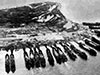 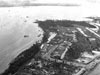 USAAF November 1944 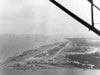 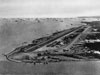 USAAF 1944 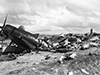 USMC December 6, 1944  USAAF Dec 12, 1944 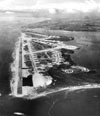 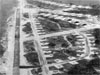 USN 1945  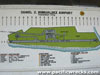 Justin Taylan 2005 |
Location Lat 11° 13' 39N Long 125° 1' 40E Tacloban Airfield is located at an elevation of 10' above sea level on the Cataisan Peninsula east of Tacloban on the northeastern tip of Leyte in Leyte Province in the Eastern Visayas (Region VIII) of the Philippines. Borders San Pedro Bay to the east and beyond Leyte Gulf. Also known as Tacloban Field, Tacloban Aerodrome or Tacloban Airstrip. Still in use today as Tacloban Airport or Daniel Z. Romualdez Airport. Construction Built prewar as a single runway oriented north to south on the Cataisan Peninsula parallel to the coast bordering San Pedro Bay to the east and Cancabato Bay to the west with Cataisan Point to the north. Wartime History During 1942, occupied by the Japanese who referred to this location phonetically as "Tacroban". In early September 1944 in anticipation of U.S. carrier plane attacks on eastern Leyte, the Imperial Japanese Navy (IJN) moved aircraft to Tacloban including elements of 901 Hikotai (S901), 153 Kōkūtai (153 Air Group) including nine J1N1-S Gekkos and two night fighter A6M5 Zeros. On September 9, 1944 three Gekkos took off on search and strike mission with two were shot down by F6F Hellcats and the third damaged. By the middle of September 1944 the surviving aircraft from S901 were withdrawn to Nichols Field. Japanese units at Tacloban Airfield S901, 153 Kōkūtai (9 x J1N1-S, 2 x Zeros) Davao arrives early Sept 1944–mid Sept 1944 departs Nichols Field On October 20, 1944 on A-Day, the U.S. Army landed on eastern Leyte. Tacloban Airfield the most important objective of the invasion and when the 7th Infantry Regiment (7th IR) landed at White Beach to the south of Tacloban turned northward to advance up the Cataisan Peninsula and captured Tacloban Airfield by the end of the day. Quickly, repairs were begun to the runway for American use. Within a week, the first U.S. planes and squadrons began to arrive. Over the next weeks and months, Tacloban Airfield was further expanded into a major airfield with taxiways and revetments that spanned nearly the entire Cataisan Peninsula. Designated U.S. Army Post Office 72 (APO 72) for Tacloban. Once repaired, used by U.S. Army Air Force (USAAF) fighters, bombers and transports plus U.S. Navy (USN) carrier aircraft and land based bombers. Although the initial Japanese air raids against Leyte targeted primarily U.S. transports and warships in San Pedro Bay and Leyte Gulf, air raids began against Tacloban Airfield with bombing and strafing often in small numbers at dusk and dawn. The nightly Japanese planes that harassed Tacloban were nicknamed "P––– Call Charlie". Japanese missions against Tacloban Airfield October 24, 1944–January 3, 1945 On October 24, 1944 Japanese planes targeted U.S. shipping off Leyte with air combat over the entire area. During the interception, a damaged FM-2 Wildcat crash landed at Tacloban Airfield. During the Battle of Leyte Gulf, Force A (Central Force) under the command of Vice Admiral Takeo Kurita that planned to attack the landing area via the San Bernardino Strait withdrew fearing that Tacloban Airfield was operational and his warships could be attacked by land based planes and failed to proceed further and engage U.S. transports. On October 28, 1944 the first plane to land on the newly repaired runway was B-25J "Lazy Daisy Mae" 43-36012. On October 29, 1944 when the U.S. Navy (USN) withdrew from Leyte Gulf, Tacloban Airfield based aircraft assumed control of direct air support over Leyte. That evening a typhoon with 50 knot winds hit the area causing damage to the tents and equipment at the airfield. On October 30, 1944 damaged XB-24D "Liberty Belle" 42-40686 force landed at Tacloban Airfield and afterwards was abandoned at the northwestern end of the runway. On November 24, 1944 parked F-5 Lightning is destroyed during a Japanese air raid. On November 26, 1944 a request by General Douglas MacArthur was made to Admiral Chester W. Nimitz to loan a U.S. Marine Corps (USMC) night fighter squadron for the defense of Leyte in exchange for a P-61 night fighter squadron. On the recommendation of Admiral Halsey, Nimitz also offered Marine Aircraft Group 12 (MAG-12). On November 28, 1944 crashed on take off is P-38L 44-23964 pilot Captain John C. Davis was killed in the crash. On December 3, 1944 twelve F6F-5N Hellcat night fighters from Marine Fighting Squadron (Night) 541 VMF(N)-541 took off from Peleliu Airfield escorted by three R5C Commandos on a flight to Tacloban Airfield arriving at 10:30am. The squadron was placed under the control of the 308th Bomb Wing (308th BW) and shared a camp area with 421st NFS. The rest of the squadron aboard a single R5C. That same day, 66 F4U Corsairs from Marine Air Group 12 (MAG-12) led by a PBJ Mitchell arrived flying from Emirau via Hollandia and Peleliu. Their ground personnel were transported aboard 5th Air Force C-47 Skytrains At 5:35pm a pair of night fighters from VMF(N)-541 flew their first mission from Tacloban to cover PT Boats in Surigao Strait with another four Hellcats conduct a dusk patrol over Ormoc Bay. The night fighters were hampered by runway lights that only worked 10% of the time and a lack of their own GCI controller and relied on less skilled Army controllers. On December 4, 1944 nine more Corsairs from MAG-12 arrived for a total of 87 Marine aircraft at Tacloban but for the rest of the day, bad weather grounded all flights. On December 6, 1944 during Japanese Te-Go (Te Operation) after 6:00pm, Ki-57 Topsy with lading lights on entered the landing pattern for Tacloban Airfield and was about to land wheels up when recognized as a enemy plane and fired on by 40mm anti-aircraft gun. Damaged, this Topsy caught on fire and crash into parked Corsairs, bounced then crashed into other planes including a grader and the cletrac. On December 12, 1944 during a short ceremony at Tacloban Airfield Major Richard I. Bong was bestowed the Medal of Honor by General Douglas MacArthur. During the presentation, he tossed away his written remarks and said, "Major Richard Ira Bong, who has ruled the air from New Guinea to the Philippines, I now induct you into the society of the bravest of the brave, the wearers of the Congressional Medal of Honor of the United States." On December 13, 1944 at 5:30am the predawn darkness with poor visibility and a low ceiling, six Corsairs from Marine Fighting Squadron 313 (VMF-313) plus two Hellcat night fighters from Marine Fighting Squadron (Night) 541 took off from Tacloban Airfield to patrol over a U.S. convoy south of Leyte bound for Mindoro. Crashed on take off is FG-1A Corsiar 14531 pilot 1st Lt. William E. Bradley (KIA) and also lost is FG-1A Corsiar 14436 pilot Major Theodore Olsen (KIA). American units based at Tacloban Airfield U.S. Army Air Force (USAAF), Far East Air Force (FEAF) 49th FG, 7th FS (P-38) Biak arrives October 24, 1944–December 30, 1944 departs San Jose 49th FG, 9th FS (P-38) Biak arrives October 24, 1944–December 30, 1944 departs San Jose 49th FG, 8th FS (P-38) Biak arrives October 25, 1944–January 2, 1945 departs San Jose 86th FW, 421st NFS (P-38, P-61) Owi arrives October 25, 1944–February 8, 1945 departs San Marcelino 71st TRG, 17th RS (B-25) Biak arrives November 2, 1944–December 23, 44 departs San Jose 71st TRG, 110th TRS (P-40 air echelon) Biak arrives November 3, 1944–December 25, 1944 departs San Jose 348th FG, 460th FS (P-47) Noemfoor arrives November 10, 1944–December 12, 1944 departs Tanauan 6th PRG, 8th PRS (F-5) Dulag arrives early November 1944–December 1944 departs San Jose 43rd BG, Headquarters (HQ) Owi arrives November 15, 1944–March 16, 1945 departs Clark Field 43rd BG, 63rd BS (B-24) Owi arrives November 23, 1944–March 19, 1945 departs Clark Field 43rd BG, 64th BS (B-24) Owi arrives November 23, 1944–March 22, 1945 departs Clark Field 43rd BG, 65th BS (B-24) Owi arrives November 24, 1944–March 16, 1945 departs Clark Field 43rd BG, 403rd BS (B-24) Owi arrives November 19, 1944–March 15, 1945 Clark Field 348th FG, 340th FS (P-47) Noemfoor arrives November 30, 1943–December 14, 1944 departs Tanauan 348th FG, 342th FS (P-47) Noemfoor arrives December 1, 1944–December 16, 1944 departs Tanauan 348th FG, 341st FS (P-47) Noemfoor arrives November 30, 1943–December 15, 1944 departs Tanauan 345th BG, 498th BS (B-25) Dulag arrives December 27, 1944–February 12, 1945 departs San Marcelino 345th BG, 499th BS (B-25) Dulag arrives December 27, 1944–February 12, 1945 departs San Marcelino 345th BG, 500th BS (B-25) Dulag arrives December 27, 1944–February 12, 1945 departs San Marcelino 345th BG, 501th BS (B-25) Dulag arrives December 27, 1944–February 12, 1945 departs San Marcelino 417th BG 672nd BS (A-20) Noemfoor arrives December 6, 1944–December 22, 1944 departs San Jose 417th BG, 673rd BS (A-20) Noemfoor arrives December 6, 1944–December 22, 1944 departs San Jose 417th BG 674th BS (A-20s) Noemfoor arrives December 6, 1944–December 22, 1944 departs San Jose 417th BG, 675th BS (A-20s) Noemfoor arrives December 6, 1944–December 22, 1944 departs San Jose 6th PRG, 20th CMS (F-7s) arrives January 25, 1945–February 24 , 1945 departs San Jose 550th NFS (P-38, P-61, P-70 det) Morotai arrives March 8, 1945–April 27, 1945 departs Zamboanga 374th TCG, 6th TCS (C-47s) Biak arrives March 12, 1945–January 1, 1946 departs Nielson 311th PW, 4th RS (F-7s) Hollandia arrives July 11, 1945–August 1, 1945 departs Clark Field U.S. Navy (USN) VPB-104 (PB4Y-1) Morotai arrives December 12, 1944–March 2, 1945 departs Clark Field VPB-117 (PB4Y-1) arrives December 1944 - February 1945 departs San Jose VPB-137 (PV-1) Mokerang arrives January 1, 1945 - February 17, 1945 departs Clark Field U.S. Marine Corps (USMC) VMF(N)-541 (F6F-5N Hellcat) Peleliu arrives December 3, 1944–January 11, 1945 departs Peleliu Marine Air Group 12 (MAG-12) Emirau arrives December 3, 1944–January 2-12, 1945 departs Tanauan VMF-115 (F4U/FG) Emirau arrives December 3, 1944–January 1945 departs Tanauan VMF-211 (F4U) Emirau arrives December 3, 1944–January 1945 departs Tanauan VMF-218 (F4U) (F4U) Nissan arrives December 3, 1944–January 1945 departs Tanauan VMF-313 (F4U/FG) Peleliu arrives December 3, 1944–January 1945 departs Tanauan Today Still in use today as a civilian airport known as Tacloban Airport or Daniel Z. Romualdez Airport. The single runway is oriented 36/18 measures 7,014' x 148' surfaced with asphalt. Airport codes: ICAO: RPVA and IATA: TAC. On November 7, 2013 Typhoon Haiyan made landfall at Tacloban with sustained winds of 195-235 mph that caused severe damage to the airport and city due to flooding, mud and destroyed structures and resulted in thousands of casualties. The next day, Tacloban Airport became the center of relief efforts when the Philippine Government ordered C-130 Hercules to land and deliver the first relief supplies and personnel. In 2024, construction began of a larger terminal building and a new control tower are under construction to expand operations. Serviced by daily flights by Philippines Airlines, Air Asia and other smaller carriers and charter flights. XB-24D "Liberty Belle" 42-40686 Pilot Grimm force landed October 30, 1944 Abandoned at the airfield Ki-57 Topsy Crash landed December 7, 1944 during Te-Go (Te Operation) paratrooper attack References NARA VMF(N)-541 War Diary December 1944 NARA VMF-218 War Diary December 1944 U.S. Army in World War II The War in the Pacific Leyte: The Return to the Philippines Chapter V A Day: 20 October 1944 pages 62, 63, 64 (map), 67, 72, 78 U.S. Army in World War II Leyte: The Return to the Philippines Chapter VI The Japanese Reaction pages 86-88 (October 24, 1944) History of Marine Corps Aviation in World War II (1952) pages 270 (October 20, 1944 landing), 271 (Battle of Leyte Gulf), 275-278 (USMC arrival Tacloban), 279 (map), 282-287 (Leyte night fighters), 288 (map), 494 (index Tacloban) Warpath Across The Pacific (2008) pages 9, 10 (map), 204 (photo Tacloban camp), 228-229 (October 20-31, 1944 Leyte), 244-245 (Tacloban arrival), 246 (map), 253-254 (B-25J force landing Tacloban), 257 (Tacloban camp life), 263-264 (photos B-25J-22 Tacloban), 327 (photo B-25 Apache Princess Tacloban), 408 (photo), 426 (photo), 428, 447 (index Tacloban) Protect & Avenge: The 49th Fighter Group in World War II (1996) pages 280 (October 31, 1944) The Eight Ballers: Eyes of the Fifth Air Force (1999) page 101 (November 24, 1944 air raid) Japanese Naval Air Force Fighter Units and Their Aces 1932-1945 (2011) page 189 (153 Ku) Ken's Men Against The Empire Vol II (2019) pages 10 (map), 161 (map), 170, 171, 175-179, 185-186 (December 6-7, 1944), 202, 206-208, 213, 216, 231, 232, 241, 243-239, 251, 254, 259, 260, 360, 362, 368-370, 376, 380, 399, 416, 418, 419, 421, 422, 424, 434, 460 (index Tacloban) Ten Days to Kamikaze – Part VII – Mass Japanese Attacks by Richard Dunn "[October 24, 1944 JAAF air raids] ...one Wildcat was hit and crashed on Tacloban airfield." Thanks to Tony Feredo for additional information Contribute
Information Last Updated
|
 Map Oct 20, 1944 Map X Corps Oct 20, 1944 Map USAAF 1945 MapFallingrain MapMapcarta  View in Google Earth  Photo Archive |
| Discussion Forum | Daily Updates | Reviews | Museums | Interviews & Oral Histories |
|