|  |
|
| |
|
| Missing In Action (MIA) | Prisoners Of War (POW) | Unexploded Ordnance (UXO) |
| Chronology | Locations | Aircraft | Ships | Submit Info | How You Can Help | Donate |
|
| IJN Hiyō class aircraft carrier 23,770 Tons (Standard) 719' 7" / 87' 7" / 26' 9" 6x2 12.7cm Type 89 guns 8 x 3 25mm AA guns Armored Belt 25-50mm Aircraft: 53 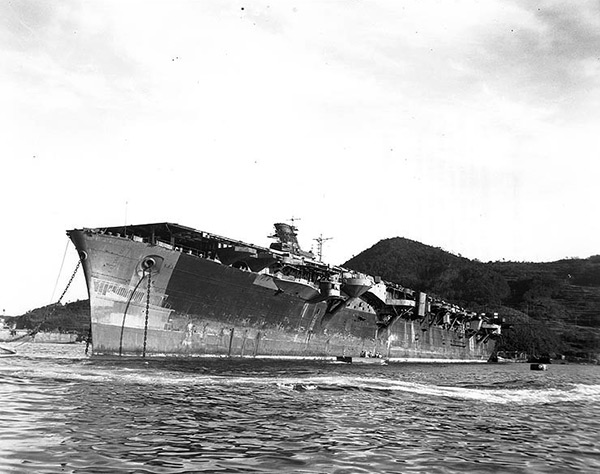 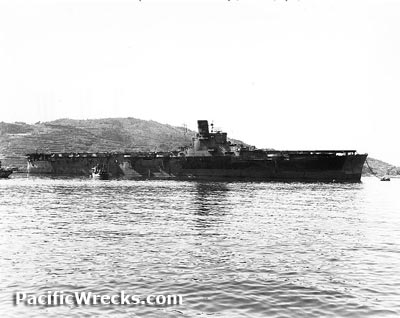 USMC Sept 26, 1945 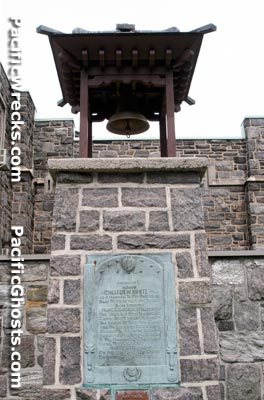 Justin Taylan 2007 |
Ship History Built by Mitsubishi Heavy Industries at Nagasaki. During late 1938 ordered by Nippon Yusen Kaisha (Japan Mail Steamship Company) as fast luxury passenger to be named Kashiwara Maru. Laid down March 20, 1939 in slipway no. 3 with yard number 900. On February 10, 1941 while under construction, Nippon Yusen Kaisha agreed to a 60% subsidy of construction costs from the Navy Ministry and was purchased for ¥48,346,000 for conversion into a Hiyō class aircraft carrier and her sister ship Idzumo Maru became Hiyō. Launched June 26, 1941 as Junyō meaning "Peregrine Falcon" also spelled Jun'yō or Junyo in English. Initially, Junyō was classified as Tokusetsu Kokubokan (auxiliary aircraft carrier) with a compliment of 53 carrier planes. Commissioned May 3, 1942 in the Imperial Japanese Navy (IJN) assigned to 1st Air Fleet, Fourth Carrier Division (CarDiv 4) under the command of Captain Shizue Ishii. Afterwards, undergoes sea trails and achived a maximum speed of 26 knots. Wartime History On May 8, 1942 arrives Saeki. On May 18, 1942 a portion of her aircraft including 18 x A6M2 Zeros from 6th Kokutai and 15 x D3A1 Vals depart Saeki Airfield and land aboard the carrier. On May 19, 1942 departs Saeki bound for Kure and almost sideswipes Battleship Yamato. On May 20, 1942 assigned to Second Carrier Striking Force, Northern Force for the upcoming Operation AL. On May 22, 1942 departs Kure with Ryūjō escorted by destroyers Akebono, Akatsuki, Hibiki, Ikazuchi and Inazuma bound for Ominato arriving three days later. On May 26, 1942 departs Ominato as the flagship of Second Carrier Striking Force's CarDiv 4 as part of Operation AL as a diversionary raid ahead of the Battle of Midway. On June 1, 1942 Junyō arrives Paramushiro and departs the same day bound for the Aleutian Islands. On June 3, 1942, at 3:25am Junyo launches 15 D3A1 Vals escorted by 13 A6M2 Zeros as part of the first strike against Dutch Harbor but face bad weather and most abort the mission with only two Zeros reaching the target. As the rest of the formation returns they spot and shoot down a PBY Catalina pilot Lt(jg) Jean C. Cusick. Afterwards, all planes land and are rearmed. At 10:45am launches 6 Zeros and 15 D3A Vals as part of the second strike against a destoyer in Makushin Bay. After take off, bad weather and icing in carburetors force all planes to abort mission and return to land. On June 4, 1942 at 4:40pm launches 5 A6M2 Zeros and 10 D3A1 Vals as part of the third strike of on a strike Dutch Harbor. At 6:10pm the Vals dive bomb oil tanks, anti-aircraft guns, hospital, naval air station and pier. Returning, the formation is intercepted by nine P-40 Warhawks and suffer the loss of 4 Vals shot down and 4 Vals damaged. At 8:26pm recovers the remaining planes and is ordered to join the Carrier Strike Force under the command of Vice Admiral Chuichi Nagumo and departs at high speed to the south. On June 5, 1942 the previous order is cancelled and Junyo is ordered to rejoin the Northern Force. At 9:00am targeted by B-26 Maurauders armed with torpedoes but was not damaged. On June 6, 1942 rejoins the Northern Force and covers the landings on Attu and Kiska. On June 24, 1942 returns to Ominato. After the Japanese loss of four fleet carriers during the Battle of Midway, Junyo was designated as Kokubokan (aircraft carrier) and her aircraft complement is changed to 21 Zeros, 12 Vals and 9 Kates. On June 28, 1942 departs Ominato as part of the Second Mobile Force, CarDiv 4 to cover the second reinforcement convoy bound for Kiska, then patrol southwest of Kiska. On July 7, 1942 departs Alaska bound for Kure arriving in the middle of the month and begins refit adding two Type 94 high-angle fire-control directors and a single Type 2, Mark 2, Model 1 radar atop the island. l On July 14, 1942 as part of fleet reorganization, assigned to Mobile Force, Air Attack in CarDiv 2, 3rd Fleet with Ryūjō. On July 20, 1942 placed under the command of Captain Tametsugu Okada. On July 28, 1942 departs Kure and three days later arrives Iwaishima. During August 1942 conducts training in the Inland Sea with Hiyo plus destroyer YUKIKAZE. During September 1942 continues training with Hiyo and destroyers Isonami and Inazuma. On August 13, 1942 enters dry dock for nine days for minor repairs. On September 14, 1942 off Saeki, the Junyo air group participates in a major training exercise, By early October 1942, the Junyo air group is now comprised of 21 A6M2 Zeros, 18 D3A1 Vals and 9 B5N2 Kates. On October 4, 1942 departs Saeki bound for Truk escorted by Isonami and Inazuma. PARTIAL HISTORY On July 20, 1942 Captain Okada Tametsugu assumed command and eight days later departs Kure. On July 31, 1942 arrives Iwaishima. During August 1942 operates in the Inland Sea and conducts training exercises with Hiyo, and destroyers. Om August 13, 1942 enters drydock at Kure for minor repairs and nine days later departs and resumes training off Saeki until the end of September 1942. Her aircraft include 21 A6M2 Zeros, 18 D3A1 Vals and 9 B5N2 Kates. On October 4, 1942 departs Saeki with Hiyo escorted by destroyers bound for Truk arriving two days later and is assigned to Main Unit Advance Force, CarDiv 2, Third Fleet. On October 11, 1942 departs Truk southward to the northern Solomon Islands. On October 14, 1942 reaches a holding position 200 miles north of Guadalcanal and provides Combat Air Patrol (CAP) and anti-submarine cover for battleships Kongo and Haruna and transports landing on Guadalcanal. On October 16, 1942 overnight proceeds to a position 180 miles north of Guadalcanal to launch an air strike at dawn. On October 17, 1942 at 7:15am Junyo launches nine A6M2 Zeros and nine B5N2 Kates armed with bombs on a mission to bomb Henderson Field and U.S. shipping off Lunga Point on Guadalcanal. Meanwhile, Hiyo launches nine A6M2 Zeros and nine B5N2 Kates. After take off, one B5N2 Kate from Junyo experiences mechanical issues and aborts the mission and returns to land safely. At 9:00am inbound to the target, the formation spot USS Aaron Ward (DD-483) and USS Lardner (DD-487) conducting a shore bombardment. At 9:27am the Kates from Hiyo target USS Aaron Ward but fail to score any bomb hits with one shot down. Shortly afterwards, the Kates from Junyo target USS Lardner but are intercepted by F4F Wildcats from VMF-121 with three shot down and two damaged and no hits. Afterwards, three more Kates are shot down by the Wildcats and anti-aircraft fire. Returning, one Kate ditches at Rekata Bay and two others land at Kahili Airfield (Buin) on Bougainville. In late October 1942 Junyō participated in the Battle of the Santa Cruz Islands (Battle of the South Pacific) during the Guadalcanal campaign. On October 26, 1942 her aircraft attacked aircraft carrier USS Enterprise CV-6, battleship USS South Dakota BB-57 and scored two hits on light cruiser USS San Juan CL-54. During the middle of November 1942, Junyō provided a covering role during the Naval Battle of Guadalcanal (Third Battle of the Solomon Sea). On January 16, 1943 Junyō departed with a convoy bound for Truk. On January 17, 1943 the Junyō detachment of twenty-three A6M2 Zeros and six B5N2 Kates commanded by Lt Cdr Takashi Hashiguch took off from Junyō and flew to Rabaul then took off again flying to Wewak Airfield (Wewak Central) on New Guinea as the first Japanese aircraft to operate from the captured civilian airfield. On thew ground, 120 personnel supported the Zeros. These aircraft were part of Operation MV to provide convoy protection as part of Hei I. Defending the Wewak area, this detachment claimed four B-24s shot down, one B-24 damaged and three B-24 probables plus uncertain results against submarines. They suffered two planes (possibly B5N2 Kates) lost, two Zeros missing and ten Zeros damaged before departing January 24, 1943 to Kavieng Airfield and January 25, 1943 to Truk then return to Junyō. Next, Junyō participated in Operation Ke-Go between the middle of January 1943 until early February 1943. During April 1943 her carrier aircraft participated in Operation I-Go land-based for a series of strikes against U.S. forces in the Solomon Islands and New Guinea. On April 7, 1943 fifteen D3A Vals took off from Ballale Airfield to strike U.S. shipping off Lunga Point on Guadalcanal and lost one plane. Next to Rabaul for strikes against New Guinea. In June 1943, Junyō helped protect an important convoy sent to reinforce the Japanese garrison on Kiska. PARTIAL HISTORY On August 15, 1943 departs Saeki with aircraft from 331 Kokutai (331 Air Group) embarked bound for Singapore escorted by Tanikaze. On August 27, 1943 off Singapore all planes from 331 Kokutai (331 Air Group) are launched and fly to Sabang Airfield. On August 28, 1943 arrives Singapore her remaining planes rehabilitate the 2nd Carrier Division air strength and by November 1, 1943 will be 24 Zeros, 18 Vals and 9 B5N. On September 4, 1943 departs Singapore bound for the Inland Sea escorted by Tanikaze. On September 11, 1943 arrives Kure and later moves to Iwakuni. On September 19, 1943 departs Iwakuni bound for Truk as part of Tei No. 1 with equipment and roughly 1,000 personnel including the 52nd Division, 107th Infantry Regiment escorted by Tanikaze. On September 24, 1943 arrives Truk and disembarks the troops and equipment. On September 28, 1943 assigned to Striking Force, 3rd Fleet, CarDiv 2. On September 29, 1943 departs Truk with Kiso escorted by Tamanami bound for Japan. On October 5, 1943 arrives Kure and later moves to Iwakuni. On October 12, 1943 departs Iwakuni bound for Truk as part of Tei No. 3 with equipment and personnel embarked with light cruiser Tatsuta and destroyers Fujinami, Suzunami, Tamanami and Hayanami. Three days later at sea rendezvous with Yamashiro and Ise. On October 19, 1943 arrives Truk and unloads. On October 31, 1943 at 8:00am departs Truk bound for Japan with Yamashiro and Ise, Tone, Tatsuta and Tanikaze and Umikaze and Suzukaze and while underway rendezvous with Unyo and Akebono that departed the previous day. On November 4, 1943 Unyo and Akebono separate bound for Yokosuka. On November 5, 1943 in the morning off Bungo Strait spotted by USS Halibut (SS-232) that fires a spread of six torpedoes and was hit by a single torpedo that killed four crew and damaged the steering. Afterwards, Tone tows the damaged carrier to Kure for repairs. On November 19, 1943 enters drydock for repairs for six days and the carrier will remain at Kure. On December 21, 1943 returns to drydock for maintenance and refit. On December 25, 1943 placed under command of Captain Kiyomi Shibuya. During this period, the carrier is armed with additional anti-aircraft guns added including four triple 25mm AA and twelve single 25mm AA.. On March 26, 1944 departs Kure for Iwakuni. On December 1, 1943 the Junyo air group transfers to Truk. At the end of December 1943 moves to Kavieng Airfield. On January 25, 1944 moves to Vunakanau Airfield near Rabaul. During late February 1944, the remaining aircraft of the 2nd Carrier Division are withdrawn to Truk and the Junyo Air Group is disbanded at Truk and return to Japan without aircraft. PARTIAL HISTORY In May 1944, with Captain Shibuya Kiyomi in command, Junyō was assigned to Operation A-Go, a sortie to repulse the expected Allied invasion of the Mariana, Palau or Caroline Islands. In the resulting battle of the Philippine Sea on 20 June 1944 Junyō was hit by two bombs at about 17:30. Her smokestack and mast were destroyed and her deck damaged. Her air operations were stopped, but she was able to withdraw without further damage, unlike her sister ship Hiyō, sunk by torpedoes. However, most of her planes were lost in the battle. After repairs at Kure, without planes, Junyō was unable to take part in the Battle of Leyte Gulf and instead was relegated to transport duties in the Philippines including transporting 18" shells for Yamato and large caliber shells for other battleships plus Shinyo suicide boats for use in the Philippines. On October 30, 1944 at Sasebo embarks 800 paratroopers from the Japanese Army 2nd Raiding Brigade, 3rd Raiding Regiment under the command of Major Tsuneharu Shirai and departs the same day bound for Manila Bay. On November 3, 1944 attacked by the submarine USS Pintado (SS-387) off Cape Bolinao on Luzon with escorting destroyer Akikaze deliberately intercepted the torpedoes and sank with no survivors. On 9 December 1944, Junyō was carrying 200 survivors of Musashi and was accompanied by the battleship Haruna and the destroyers Suzutsuki, Fuyutsuki, and Maki. The task force was attacked at midnight by the American submarines Sea Devil, Plaice and Redfish. Junyō was hit by three torpedoes, killing 19 men. Several compartments were flooded, giving her a 10°–12° list to starboard, but she was able to make way on one engine. Maki was also damaged by a torpedo. By 04:00 the Japanese task force entered shallow waters where the American submarines could not follow. Afterwards, Junyō was dry docked at Kure. By March 1945, repairs were abandoned due to a lack of materials, fuel and carrier planes. Also because there was no longer any need for fleet carriers. By the end of the Pacific War, Junyō remained anchored at Sasebo. Fate During 1947, Junyō was broken up for scrap. Ship's Bell During 1944, the ship's bell from Junyō was recovered by the U.S. Navy (USN) on Saipan and later presented to Admiral Chester W. Nimitz. On May 11, 1946 donated to Fordham University in Bronx, New York as a memorial to American dead from World War II. The bell is displayed in a wooden pagoda shaped enclosure on a stone pillar with a brass plaque that reads: "As a Memorial to Our Dear Young Dead of World War II." It was blessed by Cardinal Spellman, and "Was first rung at Fordham by the President of the United States, the Honorable Harry S. Truman on May 11, 1946, the Charter Centenary of the University." References Combined Fleet - IJN Junyo: Tabular Record of Movement Thank to Richard Dunn for January 1943 Junyo detachment information Contribute
Information |
 Photo Archive  View in Google Earth |
| Discussion Forum | Daily Updates | Reviews | Museums | Interviews & Oral Histories |
|