Marine Fighting Squadron 211 (VMF-211) "Avengers"
United States Marine Corps (USMC)
Background
Commissioned January 1, 1937 as Marine Fighting Squadron 4 (VF-4M) at NAS San Diego in the U.S. Marine Corps (USMC). On July 1, 1937 redesignated as Marine Fighting Squadron 2 (VMF-2) equipped with the F2F-1, F3F-1 then F3F-2. During January 1941 moved to Ewa Field on Oahu and redesignated Marine Fighting Squadron 211 (VMF-211) in Marine Air Group 21 (MAG-21) and transitioned to the F4F-3 Wildcat.
On November 27, 1941 the squadron received secret orders
for deployment. In the afternoon, twelve F4F-3 Wildcats were flown from Ewa Field to NAS Pearl Harbor on Ford Island.
On November 28, 1941 the squadron's F4F Wildcats were embarked aboard USS Enterprise (CV-6). F4F Wildcat 4031 had starter trouble remained behind and F4F Wildcat 3988 from VF-6 was substituted before departure bound for Wake Atoll. During the voyage, the Wildcats were repainted and had their engines, armament and radio equipment checked.
On December 2, 1941 in the morning, the twelve F4F Wildcats were flown off USS Enterprise (CV-6) roughly 175 miles off northeast of Wake Atoll and land at Wake Island Airfield with assistance from SBDs from VB-6 and a PBY Catalina from Peale Island Seaplane Base at Wake Atoll. When they arrived, there were no facilities on the ground. The runway was sufficient length but was deemed to be too narrow and was only safe for use by one plane at a time and parking space was restricted. Refueling was done by a bowser truck but the trucks were refueled by hand pumps from drums. On December 4, 1941 the squadron and civilian contractors began building revetments for planes and began flying 360° patrols at a distance of 50 miles around Wake Atoll plus familiarization and training flights by flights of four planes from dawn to dusk. On December 6, 1941 after months of working seven days a week, the contractors and Marines of the 1st Defense Battalion took the day off including VMF-211 personnel.
Wartime History
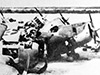
On December 8, 1941 at the start of the Pacific War, Type 96 / G3M2 Nells from Chitose Kōkūtai (Chitose Air Group) bomb Wake Island and Wake Island Airfield damaging or destroying seven newly arrived Wildcats parked on the ground including F4F Wildcat 4024, F4F Wildcat 4027, F4F Wildcat 4028, F4F Wildcat 4030, F4F Wildcat 4032, F4F Wildcat 4037 and F4F Wildcat 4041. Afterwards, the damaged planes are stripped for usable parts leaving four Wildcats to defend Wake Atoll.
At the start of hostilities, civilian contractors from Morrison-Knudsen Company volunteered to aid the squadron with maintenance of aircraft and later as ammunition carriers or manning beach defenses on Wake Island.
On December 11, 1941 Japanese force attempt an amphibious landing at Wake Island and were repulsed by shore batteries that hit and sinks Hayate and scores a hit on Yayoi that causes minor damage. While the Japanese were withdrawing, attacked by F4F-Wildcats from VMF-211 armed with 100 pound bombs. F4F-3 Wildcat 4019 pilot Captain Henry T. Elrod is credited with dropping a bomb that hit Kisaragi in the bridge and caused an internal explosion and sank. Landing at Wake Island Airfield his Wildcat was damaged beyond repair and written off. The sinking was claimed to be the first destroyer sunk by a bomb dropped by a fighter aircraft.
On December 14, 1941 lost is F4F-3 Wildcat 4020 during take off from Wake Island Airfield ground looped and damaged, afterwards the wreckage was used as a decoy on the runway. Lost in air combat is F4F Wildcat 3980 over Wake Atoll.
On December 15, 1941 squadron personal on Oahu are embarked aboard
Task Force 14 (TF 14) as reinforcements bound for Wake Atoll.
On December 21, 1941 lost is F4F-3 Wildcat 3988 shot down by a Japanese Zero over Wake Atoll. While patrolling, F4F-3 Wildcat pilot 2nd Lt David D. Kliewer spots Japanese submarine RO-60 on the surface roughly 25 miles southwest of Wake Atoll and attacks the submarine, strafing and drops two 100 pound bombs that damage the periscope and holed several of the diving tanks and crash dives to escape. Kliewer claimed the submarine as sunk but in fact it had only crash dived and later earned the Silver Star for his attack.
On December 22, 1941 on an interception mission F4F Wildcat 4022 pilot Captain Herbert C. Freuler claimed three Japanese planes shot down, the third exploding and damaging his plane and hit by gunfire from a A6M2 Zero from Hiryu and was wounded but managed to crash land at Wake Island Airfield.
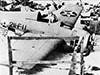
On December 23, 1941 during the early morning, the second Japanese invasion force arrives off Wake Island and Special Naval Landing Force (SNLF) troops make an amphibious landing. In a last-ditch effort, Captain Henry T. Elrod helped organize the remaining garrison including civilians to man beach defenses to repel the Japanese landing. Several times, Elrod provided covering fire for men carrying ammunition for gun emplacements until he was shot and killed. He later earned the Medal of Honor for his actions during December 1941. After a short battle, the U.S. garrison surrenders including the remaining Marines of VMF-211. The squadron's planes including F4F 4019 and F4F 4022 are captured at Wake Island Airfield.
Afterwards, reorganized and nicknamed Nickname “Avengers” in the memory of the members of the squadron who were killed or captured at Wake. On April 14, 1942 fourteen F2A Buffalos were embarked aboard USS Lexington (CV-2) and the next day depart bound for Palmyra. On April 18, 1942 the squadron's F2A Buffalos launch from USS Lexington (CV-2) and land at Palmyra Airfield.
During May 1943 the squadron returns to Ewa Field and converts to the F4U Corsair. During August 1943 departs for Espiritu Santo.
In October 1943 the flight echelon moves to Russell Islands and supports the U.S. landings on Bougainville.
During December 1943 the squadron moves to Torokina Airfield on Bougainville.
On January 3, 1944 twelve Corsiars from the squadron took off from Torokina Airfield on a mission over Rabaul.
On January 13, 1944 Corsiars from the squadron took off from Torokina Airfield on a search mission escorting a PBY Catalina. Lost is F4U-1A Corsair 18045 pilot Captain Adolph R. Vetter (MIA).
On January 14, 1944 twelve F4U Corsiars from the squadron took off from Torokina Airfield in three divisions escort SBD Dauntless over Rabaul. Lost is F4U Corsair 17807 pilot 1st Lt. Nathaniel R. Landon, Jr. (MIA). Damaged F4U Corsiar 17907 pilot 1st Lt. M. R. Tutton (rescued) bailed out over Torokina.
On January 20, 1944 Corsairs from the squadron took off from Torokina Airfield on a mission to escort B-25 Mitchells from 42nd Bombardment Group (42nd BG) on a bombing mission against Vunakanau Airfield near Rabaul. F4U Corsair pilot 1st Lt C. I. Cobb, Jr. was damaged by 20mm anti-aircraft fire.
On January 23, 1944
Corsairs from the squadron took off from Torokina Airfield on an escort mission over Rabaul.
On
January 30, 1944 Corsairs from the squadron took off from Torokina Airfield on an escort mission over Rabaul. Lost is FG-1A Corsair 13215 pilot Major H. L. Hopkins.
On
February 29, 1944 lost is FG-1A Corsair 13271.
On
March 12, 1944 lost is FG-1A Corsair 13297.
During March 1944 part of the squadron moves to Nissan Airfield (Green) in Green Island Atoll.
On April 25, 1944 moves to Emirau Airfield. During May 1944 joined by the rear echelon.
On December 1, 1944 prepares for a movement to Leyte in the Philippines.
On December 2, 1944 at 4:00am squadron departs aboard a R4D on a flight to Peleliu and over night.
On December 3, 1944 at 4:00pm the squadron aboard R4D arrives Tacloban Airfield on Leyte with some personnel delayed.
On December 4, 1944 operations were scheduled to commence but due to bad weather as some delayed pilots arrive.
On December 5, 1944 the squadron begins flying patrols from Leyte with nil sightings.
While taking off for the first patrol, lost is F4U-1D Corsair 57490 pilot Lt. Jerome G. Bohland who crashed and was killed.
Afterwards, the squadron covers the U.S. landings at Ormoc Bay and Mindoro.
During January 1945 supports the U.S. landings at Lingayen Gulf on Luzon.
During February 1945 supports landings at Biri and Capul.
During March 1945 supports the landing at Zamboanga and joined by the ground echelon.
During April 1945 supports landings at Bongao, Jolo and Malabang.
During July 1945 operates from San Roque Airfield (Moret Field) near Zamboanga on Mindanao and covers the landings at Sarangani Bay and supports ground forces on Mindanao until the end of the Pacific War.
During September 1945 particiaptes in the U.S. occupation of areas on the mainland of China.
Postwar
During 1952 while operating on board USS Coral Sea redesignated VMA-211. In 1957, the Squadron received A-4E Skyhawk and subsequently moved to El Toro, California. In 1965, moved to Japan then deployed to Vietnam. In August 1976, the squadron returned to El Toro and transitioned to the A-4M Skyhawk. After a unit deployment to the western Pacific, VMA-211 relocated to Marine Corps Air Station, Yuma, Arizona. On December 10, 1987 and was assigned to Marine Air Group 13 (MAG-13) operating the AV-8B Harrier II.
Today
On May 9, 2009 the squadron received their first two F-35B Lightnings. On June 30, 2016 redesigned VMFA-211 and became the second squadron in the U.S. Marine Corps to operate the F-35B Lightning.
References
NARA "Report of VMF-211 on Wake Island" October 18, 1945
NARA "Marine Fighter Squadron 211 (VMF-211) War Diary January 1944"
NARA "Aircraft Action Report (AAR) VMF-211 January 20, 1944"
The Hall of Valor Project - David D.
Kliewer Silver Star citation indicates the date of the attack as December 15, 1941 [sic December 21].
History of Marine Corps in World War II (1952) page 460 (VMF-211 squadron summary)
Centennial of Naval Aviation "Wildcat to Harrier: VMA-211 celebrates combat history" Vol. 1, Issue 2 Fall 2009 page 9
Thanks to Mickeen Hogan for additional information
Contribute Information
Do you have photos or additional information to add?
|